Clickz has announced the winners of their Marketing Excellence Awards for six categories; Ad Management, Analytics, E-mail Marketing Tool, Mobile Marketing Tool, Search Ad Management and Social Media Marketing Platform or Tool.
And the winners of the 2009 Marketing Excellence Awards are...
Winners were judged on four criteria:
1. Ability to help marketers innovate and execute
2. Ability to help marketers measure and achieve goals
3. Ability to integrate with other digital marketing tools
4. Overall approach and category relevance
The solutions that were considered were limited to those who paid for the privilege to be judged so some of the top solution providers are not even mentioned i.e. Google Analytics. While I wouldn't rely on this list for deciding on a vendor, you should at least consider these vendors in your selection process. You may also want to consider last years Marketing Excellence Award winners.
Showing posts with label Advertising. Show all posts
Showing posts with label Advertising. Show all posts
Monday, May 11, 2009
Wednesday, March 11, 2009
A Better Banner?
Competition for online advertising dollars has never been more intense. Banners were once king but have continued to lose ground to more responsive ads. Overture (now Yahoo Search)introduced and Google perfected text ads next to search results where advertisers only pay if visitor clicks on the ad. The next threat comes from social networks like Facebook and MySpace which are improving their targeting of ads based on users' interests, online activities and their circle of friends.
While these new efforts are highly targeted, there is still demand for reaching the masses. Even as marketers shift budgets from mass media, there is still the need to reach customers who don't know that they NEED your product.
To meet this demand while combating banner blindness, twenty-seven large publishers, members of the Online Publishers Association (OPA), are introducing three new types of online display ads. The new formats are meant to reduce clutter while getting more directly into the generic consumer's face.
The publishers involved in this initiative, including national newspapers like The Wall Street Journal and USA Today, magazines like Forbes and Condé Nast and multimedia sites like MTV Networks and ESPN are hoping these new ad formats will strike a balance in getting more reader attention without driving readers away.
The proposed new advertising units are:
* The Fixed Panel (recommended dimension is 336 wide x 860 tall), which looks naturally embedded into the page layout and scrolls to the top and bottom of the page as a user scrolls.
* The XXL Box (recommended dimension is 468 wide x 648 tall), which has page-turn functionality with video capability.
* The Pushdown (recommended dimension is 970 wide x 418 tall), which opens to display the advertisement and then rolls up to the top of the page.
Publishers will offer at least one of these three new ad formats to advertisers by July.
Note that these formats are not part of the standards supported by the Interactive Advertising Bureau (IAB). According to Business Week the IAB is open to adopting these new formats but so far the OPA appears intent on keeping the formats to just its members. So for now you will need to deal directly with the publishers to test these formats as they will not be offered as part of a network by third parties.
While these new efforts are highly targeted, there is still demand for reaching the masses. Even as marketers shift budgets from mass media, there is still the need to reach customers who don't know that they NEED your product.
To meet this demand while combating banner blindness, twenty-seven large publishers, members of the Online Publishers Association (OPA), are introducing three new types of online display ads. The new formats are meant to reduce clutter while getting more directly into the generic consumer's face.
The publishers involved in this initiative, including national newspapers like The Wall Street Journal and USA Today, magazines like Forbes and Condé Nast and multimedia sites like MTV Networks and ESPN are hoping these new ad formats will strike a balance in getting more reader attention without driving readers away.
The proposed new advertising units are:
* The Fixed Panel (recommended dimension is 336 wide x 860 tall), which looks naturally embedded into the page layout and scrolls to the top and bottom of the page as a user scrolls.
* The XXL Box (recommended dimension is 468 wide x 648 tall), which has page-turn functionality with video capability.
* The Pushdown (recommended dimension is 970 wide x 418 tall), which opens to display the advertisement and then rolls up to the top of the page.
Publishers will offer at least one of these three new ad formats to advertisers by July.
Note that these formats are not part of the standards supported by the Interactive Advertising Bureau (IAB). According to Business Week the IAB is open to adopting these new formats but so far the OPA appears intent on keeping the formats to just its members. So for now you will need to deal directly with the publishers to test these formats as they will not be offered as part of a network by third parties.


Tuesday, March 3, 2009
Should You Pay Bloggers To Talk About Your Brand?
 Forrester Research just released a new brief about “Sponsored Conversations.” The briefing suggests that advertisers should “Add Sponsored Conversations to Your Toolbox”.
More and more blogs are participating in some form of sponsored conversation or sponsored blogging. The tight economy and resultant push for more efficient methods of advertising are driving bloggers and advertisers to explore this option more everyday. Since display ads don’t work in social media perhaps an "advertorial" will work. It has worked for other media.
Printed magazines run paid advertorials, forms of advertising that incorporate editorial elements such as headlines and quotes and read like an article. While these are generally labeled as advertising the online magazines do the same but the separation of editorial and ads is less clear. Paid product placement in TV and Movies is common without any mention of sponsorship. Economic pressures will continue to tear down the wall between advertising and editorial departments even in our once sacred blogs.
Sunday, February 22, 2009
Online Marketing Spending to Increase in 2009
A survey by Alterian reports that most companies will increase their investment in online marketing in 2009, but the ROI on that investment may be sketchy. Less than half (47%) of marketing professionals in North America and the U.K. recently surveyed reported that they currently use analytics to measure online campaign results. One-quarter cited analyzing and honing results as the hardest part of any campaign.
Nearly two-thirds (62%) of organizations surveyed reported planning to increase online marketing this year, 26% said online investment would remain static, and 6% said it would decrease.
Nearly two-thirds (62%) of organizations surveyed reported planning to increase online marketing this year, 26% said online investment would remain static, and 6% said it would decrease.
Thursday, February 5, 2009
Newspapers in Crisis: Migrating Online
US newspaper ad revenues are expected to drop 42.5% in the next seven years. Can newspapers survive? Readership continues to move online and to more real-time, interactive venues, according to a report from eMarketer.
In its report, “Newspapers in Crisis: Migrating Online,” the research firm estimates that newspaper advertising revenues dropped 16.4% to $37.9 billion in 2008 and expects that by 2012, those revenues will slide to $28.4 billion - about one-half the industry’s revenue peak in 2005.
In its report, “Newspapers in Crisis: Migrating Online,” the research firm estimates that newspaper advertising revenues dropped 16.4% to $37.9 billion in 2008 and expects that by 2012, those revenues will slide to $28.4 billion - about one-half the industry’s revenue peak in 2005.
Sunday, February 1, 2009
Newspaper Web Site Visitors Grow 27%
The Web sites of the top 10 newspapers in the US saw a 16% year-over-year increase in unique visitors in 2008. They also experience a 27% increase in the total number of overall visits according to data from Nielsen Online.
Monday, April 28, 2008
Online Display Ads Get Best ROI
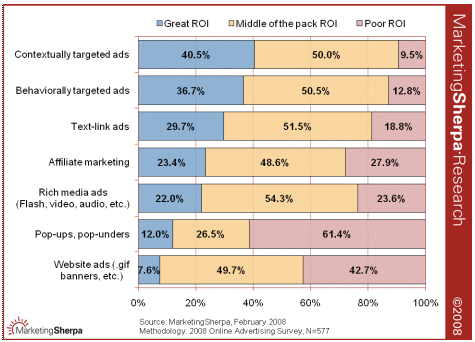
Online ads suffer because they’re branding units that offer the possibility of a direct click, so they’ve often been judged on the basis of clickthroughs. But, as advertisers and publishers become more sophisticated, the metrics and methods of success are improving.
The nature of targeting is evolving rapidly as real-time logic decides which ad to serve when and the reach of large networks allows for niche audiences to be pulled from the crowd and treated differently.
Advertisers rate the ability to use behavioral and contextual targeting as key drivers of ROI. Major brand studies also cite targeting as the key element of success and show that ads were more effective in 2007 than they were previously. That’s a trend that should continue.
The key takeaway for advertisers is that the context in which an ad is served is at least as important as the ad itself. It’s no different than traditional direct marketing; the list is the most important variable in a successful campaign.
An impression is wasted if the consumer is not in the proper state of mind, or simply does not fall into the group of people who would have reason to consider the offer. From an ROI perspective, eliminating wasted impressions, then making a good impression by serving up great advertising, is consistently the best option for advertisers.
The nature of targeting is evolving rapidly as real-time logic decides which ad to serve when and the reach of large networks allows for niche audiences to be pulled from the crowd and treated differently.
Advertisers rate the ability to use behavioral and contextual targeting as key drivers of ROI. Major brand studies also cite targeting as the key element of success and show that ads were more effective in 2007 than they were previously. That’s a trend that should continue.
The key takeaway for advertisers is that the context in which an ad is served is at least as important as the ad itself. It’s no different than traditional direct marketing; the list is the most important variable in a successful campaign.
An impression is wasted if the consumer is not in the proper state of mind, or simply does not fall into the group of people who would have reason to consider the offer. From an ROI perspective, eliminating wasted impressions, then making a good impression by serving up great advertising, is consistently the best option for advertisers.
Subscribe to:
Posts (Atom)