E-Marketing in Minneapolis David Vinge, eMarketing Dashboard : Social Media Marketing
Showing posts with label Social Media Marketing. Show all posts

Wednesday, January 5, 2011

Kraft Foods Spaming Twitter Users Using FourSquare Checkins

Location-based social networking is a growing trend that is ready to be abused and Kraft Foods has found a way.  They are now apologizing for their location based tweets after complaints from victims.

Kraft Foods has had some recent spikes in tweets recently. For example on January 3 they sent out 201 tweets. The tweets have been location based mentioning retailers such as Costco and Stop'n Shop.  One example, "@vinge While you're at Costco, check out this delish Ritz Cheesy Football for your football parties!"
It appears that they are using foursquare checkins to target Twitter users with robo spam. This has backfired and Kraft Foods has been sending out apologies.


It appears that Kraft Foods may have been using Local Response  "but have turned it off until we get it right." Can anyone confirm?


Thursday, October 7, 2010

Social Media for B2B Sales

The InsideView blog has released an Infographic depicting "The Social Media landscape - Facts and Figures for B2B Sales."

Some of the highlights are as follows:


Global Fortune 100 Companies with social profiles:
  • Twitter 65%
  • Facebook 54%
  • YouTube 50%
  • RSS Feeds 33%
Average Social Media Activity of Fortune 100 companies
  • 27 tweets per week
  • 3.6 Facebook posts per week
  • 7 blog posts per month
  • 10 videos per month
It also says that "A negative customer review on YouTube, Twitter of Facebook can cost a company about 30 customers."

Forrester estimates that $716 million will be spent on social media this year and will grow to $3.1 billion in 2014. But this is still just a fraction of the size of search or display advertising at $31.6 billion and $16 billion respectively. Perhaps this is because search and display have proven ROI's.  See also "Social Media Is Not Free - Measuring ROI."

Monday, August 30, 2010

Seniors Gaining Momentum in Social Media, But...

Social networking use among Internet users ages 50 and older nearly doubled in the year ending May 2010, jumping from 22% to 42%. During that year social network usage among young people only grew 13% but they still dominate social networks. This repeats the pattern of Web adoption where adults 50 to 65 started out slow but at one time exceeded usage by young adults 18 to 24. 

According to Pew Internet Report author Mary Madden, e-mail still dominates online communication for the 50 and older set as it does for adults in general.

From the Pew Internet Report:
  • Between April 2009 and May 2010, social networking use among Internet users ages 50-64 grew by 88%--from 25% to 47%.
  • During the same period, use among those ages 65 and older grew 100%--from 13% to 26%.
  • By comparison, social networking use among users ages 18-29 grew by 13%—from 76% to 86%.

Wednesday, August 25, 2010

Social Media Is Not Free - Measuring ROI

I have always preached that for Interactive Marketing, if you can't measure it then it's not worth doing.

Survey results released this week by Alterian found that "Thirty-seven percent of respondents said they are not able to measure ROI when it comes to the socialization of their brand, and 42 percent reported to be only somewhat able to measure ROI."

A year ago eMarketer reported that "84% of respondents said they don’t currently measure the ROI (return on investment) of their social media programs."

Measuring the ROI of social media activities is difficult because there are so many factors to measure and track. Below is a slide show by Olivier Blanchard that does a great job of explaining what ROI is and how it relates to Social Media.  Spoiler Alert! Although this story has a happy ending, your results may vary.

Friday, August 20, 2010

Can You Protect Your Privacy From Facebook Places?

Click to enlarge.
On August 18, Facebook introduced  Places, a new location feature that competes with other popular location services like Google Latitude, Foursquare, Loopt, and Gowalla. Places allows users to 'check in' to locations and to tag their friends as present (similar to tagging friends in photos). Everyone who is checked in to the location can see who else is listed as "Here Now" for a few hours after they check in. If you are checked in to a location, Places creates a thread in your friends' News Feeds and places a notice in the location's page's Recent Activity section. Places will roll out over the next few days.

Note that even if you do not desire to report your location in Places, your friends might tag you as "Here Now" - even if you're not.

Places is Facebook's most significant launch since the highly controversial release of  Connections and Instant PersonalizationRead more about the controversy:

Tuesday, August 17, 2010

A Taxonomy of Social Networking Data

Do you know who has your personal data?

Info security expert Bruce Schneier has developed an interesting and useful taxonomy of social networking data.

It was published in the July/August 2010 issue of IEEE Security & Privacy and Mr. Schneier has made a copy of the taxonomy article on his web site.

Bruce provides a way to categorize data provided to social networking sites when we discuss privacy issues and the rights people have with respect to their data.

In the article the following types of social networking data are defined:
  • Service data is the data you give to a social networking site in order to use it. Such data might include your legal name, your age, and your credit-card number.
  • Disclosed data is what you post on your own pages: blog entries, photographs, messages, comments, and so on.
  • Entrusted data is what you post on other people's pages. It's basically the same stuff as disclosed data, but the difference is that you don't have control over the data once you post it -- another user does.
  • Incidental data is what other people post about you: a paragraph about you that someone else writes, a picture of you that someone else takes and posts. Again, it's basically the same stuff as disclosed data, but the difference is that you don't have control over it, and you didn't create it in the first place.
  • Behavioral data is data the site collects about your habits by recording what you do and who you do it with. It might include games you play, topics you write about, news articles you access (and what that says about your political leanings), and so on.
  • Derived data is data about you that is derived from all the other data. For example, if 80 percent of your friends self-identify as gay, you're likely gay yourself.
So, some data is demanded by social networking sites and you expect it to be kept in confidence, Some data you willing publish openly to let others find you and some you publish for only your network of friends.    

Keep in mind that social networking sites can monetize all of it: generally by selling targeted advertising.

Monday, August 2, 2010

Health Care Study: Using Social Networks to Discuss Conditions with Fellow Patients

About one-third of Americans who go online to research their health currently use social networks to find fellow patients and discuss their conditions.

According to a new Issue Brief by the Deloitte Center for Health Solutions, "Public, Internet-based social networks can enable communication, collaboration and information collection and sharing in the health care space."

In the brief, “Social Networks in Health Care: Communication, Collaboration and Insights,” they also report that 60% of physicians and 65% of nurses are interested in using social networks for professional purposes.

"Social networks hold considerable potential value for health care organizations because they can be used to reach stakeholders, aggregate information and leverage collaboration."

Read the full document (PDF).

Friday, July 30, 2010

YouTube Banned Again

A court in Russia has just blocked YouTube. Other countries that have blocked YouTube are China, Libya, Morocco, Turkey and Iran. But China, Morocco and Turkey later lifted their bans.

The Russian court's ruling further threatens free speech by blocking four other web sites for “extremist” content. This includes the Internet Archive web.archive.org which stores old copies of deleted Web pages, and three Russian online libraries.

From the Moscow Times article - "The Internet is widely recognized as the last uncensored media in Russia, and the ruling nudges the country toward the likes of Iran and Pakistan, which have blocked YouTube."

By banning YouTube completely they are also blocking President Dmitry Medvedev's Kremlin channel which, by the way, blocks viewers from leaving comments.

Read the entire article at the The Moscow Times.

Wednesday, July 14, 2010

Twitter Introduces @earlybird Magical Deals

On July 6, Twitter announced that they would start to lay golden eggs on their account, @earlybird. These are actually "magical deals" offered by Twitter's advertising partners. These exclusive offers appear every few days and are expected to be short-term deals or event promotions for the Twitter community. The first offer appeared on July 14 from @DisneyPictures to promote the Sorcerers Apprentice .

More from Twitter:

Why are you doing this?
Many of you use Twitter to stay on top of timely, relevant information, and lots of businesses are already sharing special offers on Twitter. We believe that surfacing deals through the @earlybird account will help you discover the best of those deals, as well as find and follow accounts that consistently provide exceptional value.

Tuesday, April 13, 2010

Social Media Sharing Trends - Email Still Rules

The popular social bookmarking service, Tell-a-Friend,  analyzed the 10 million referrals that happened via Tell-a-Friend and compiled a report of the findings.
Key findings include:
  • The top channels of sharing include, email (59%), instant messenger (25%), social networking sites (14%).
  • Email and IM continue to be the most popular mediums of sharing
  • Facebook with a 79% share dominates the sharing in the social networking channel
  • Twitter is growing in popularity but is still just 5% among social networks.
  • Only 2% of shares happen over Bookmarking sites but digg rules this method.
  • In the Email channel, Yahoo Mail is the most preferred, followed by MSN.
  • Google’s services like Google Bookmarking, Google Talk, and Gmail, are lagging in their respective channels when it comes to shared content
  • LinkedIn, as a networking site, ranks the lowest when it comes to social media sharing.

Read the complete report at Tell-a-Friend.

Wednesday, March 31, 2010

Should Employee Access to Social Networks Be Blocked?

Is it a waste of time for your staff to spend two to three hours on Facebook, Twitter, LinkedIn and other social networks or does it increase customer engagement? Some large companies have decided against social media access. In this article CorMetrics attempts to provide "5 reasons NOT to seal your social media borders."

They outline five critical questions that must be answered before blocking employee access to social networks.  While I disagree with some of their arguments and logic, I do agree with their conclusion.

Saturday, March 27, 2010

Seniors and Social Networking: Facebook vs. Twitter

Seniors have a significant presence on Facebook with women in this age category up more than 175% since fall 2008 and men up almost 138%, according to the Pew Research Center and eMarketer.

In this article by Marketing Vox, Varsity, which focuses on senior marketing research, points to AARP.org's year-old social networking platform - which now has 350,000 users in 1,700 groups - as additional proof that seniors have become an important social network constituency.

Twitter, though, is an exception, say Amy Beamer, COO, "We are not seeing that many tweets from seniors. Facebook, yes. Blogging, definitely yes." In some part, this is a reflection of larger trends: Facebook is growing faster than Twitter, generally.

But for seniors specifically, Facebook is more attractive from a utilitarian perspective. "It is easier to keep up with grandchildren or adult children on Facebook."

Beamer has these suggestions for reaching out to seniors on Twitter
  1. Give them a better sense of what is in it for them to use Twitter. Such strategies could be anything from offering coupons or Twitter-specific sales to enticing people from their generation to Tweet on issues.
  2. Identify the topics in which they are interested. For example, there were signs that seniors were following the health insurance overhaul debate on Twitter, Beamer says. Less obvious but equally compelling topics would be RV travel or time share management - subjects of big interest to active seniors.
Read the article...

Sunday, March 21, 2010

Happy Birthday Twitter

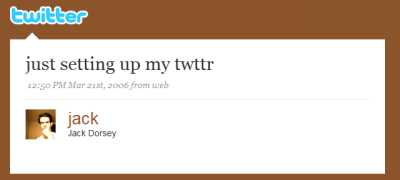
According to Wikipedia, the first tweets were published on March 21, 2006, exactly 4 years ago. Happy Birthday Twitter.

Jack Dorsey published the first Twitter message at 9:50 PM Pacific Standard Time (PST), March 21, 2006: "just setting up my twttr".

This post was followed by Biz Stone with his first post at 12:51 PM: "just setting up my twttr"

And the rest is history.

Monday, March 1, 2010

Microsoft Adds LinkedIn Plugin to Outlook

In February, Microsoft released a "beta" test version of the Outlook Social Connector. The add-on software, which was first announced last November, adds a new pane to the main e-mail reading screen on Outlook. When a user clicks to read an e-mail message, the new pane fills up with the sender's most recent social-networking activities. Those could include the addition of a professional contact on LinkedIn or a "what I'm doing now" status update from Facebook.

Microsoft's new software will also treat Outlook itself as a social network. If the e-mail sender and recipient are jointly working on a document stored on a company's Sharepoint server, both will see updates if one logs on to make edits.

For now, the new software doesn't let people use Outlook to push information back up to LinkedIn, Facebook or other sites. But you can invite people in your Outlook contacts to join your professional network on LinkedIn.

Thursday, January 21, 2010

Marketers Investing Heavily in Social Media in 2010

The seventh annual survey on marketing investments was released today by integrated marketing services provider Alterian.

The survey covered 1068 marketing professionals - 98% in North America and Europe and 2% in Asia Pacific and other regions.

Results highlights
  • 66 percent of respondents will be investing in social media marketing (SMM) in 2010.
  • Amoung those planning to invest, 40 percent said they would be shifting more than a fifth of their traditional direct marketing budget towards funding their SMM activities.
  • More than a third (36 percent) of respondents are investing in social media monitoring and analysis tools.
  • Nearly half of respondents (42%) said they don’t currently incorporate clickstream and web analytics data into their customer and e-mail database.
  • The research also found that over half of respondents (51 percent) are placing a ‘fair’ or ‘significant’ amount of effort on moving from a campaign-centric direct marketing model towards multichannel customer engagement – in fact only 7 percent make no effort at all.
 Note that these results were compiled by a company that sells support services for social media marketing.
 
Get a copy of the full report of the Alterian Annual Survey results.

Tuesday, January 19, 2010

Twitter Growth Declining

Today Hubspot released its third State of the Twittersphere report, which shows a significant decline in the growth of Twitter users but also indicates the average Twitter user is more engaged.

 
Highlights of the Report
  • Twitter user growth peaked at 13% in March 2009 by October it was down to 3.5%
  • Traffic to Twitter.com has declined but may be an indication that more people are using third-party applications such as TweetDeck
  • Today the average Twitter account has 300 followers; in July, it had 70
  • The average account now follows 173 accounts; in July it was only following 47
  • The average account today has posted 420 updates; in July that number was 119
  • Peak tweeting time is in the evening between 10 and 11pm
  • The highest usage days for Twitter are Thursday and Friday. The lowest usage is on the weekend.
Note that the averages are deceptive as a few very large accounts can skew the results. About 82% of Twitter users have less than 100 followers and are following less than 100 people themselves.

Download the full January 2010 report. Or download the July 2009 and December 2008 reports.

Wednesday, December 30, 2009

Can Social Media Help Small Biz?


My favorite local wine bar/coffee shop has Twitter Tuesdays. Give your Twitter name at the drive-up window and get a free cup of coffee if you are on their follower list (only about 57 so far). They've kept it going for a month and say that it is here to stay. Hmm... They must be selling a lot of breakfast sandwitches with that free coffee. Last week they had a one-night coupon on Facebook good for "one free wine or beer from 7 p.m. to 11 p.m."   They've been open less than six months.  I hope they survive.

Lead generation/new customer aquistion should be the top business benefit derived from social media for small businesses. But in a survey from Citibank, the majority of small-business executives found social networks no good for expanding their business.

But contrast this with the “Small Business Marketing Forecast 2010” from Ad-ology - lead generation is the biggest benefit of social networking for US small businesses, cited by one-half of respondents. Social networks were also considered a good way to keep up with the industry and monitor online chatter about the business.

Small businesses rated Facebook the most beneficial social networking site, with one-third of respondents reporting it was at least somewhat helpful. It was also the social network most likely to be used. Use of LinkedIn was less common, but the business-oriented site was claimed as beneficial by 21% of small businesses, compared with 19% that said the same of Twitter.

While awareness of social media is high among small businesses, education is still needed. Nearly one-half of respondents wished they knew more about the channel, and some of the biggest obstacles to doing more with social networking included a lack of knowledge.

The No 1. roadblock, however, was the perception that “our customers do not use social networks,” claimed by 31% of small businesses. Nearly as many complained that they did not have the time or staff available to do a good job with social network marketing. I'm sure this is true. So what would be the ROI if they outsourced this activity to a profressional? Is anyone willing to be paid based on performance? How would performance be measured?

Sunday, December 20, 2009

Social Media Facts: Blogs


Wikipedia says: A blog is a type of website, usually maintained by an individual with regular entries of commentary, descriptions of events, or other material such as graphics or video. Entries are commonly displayed in reverse-chronological order. “Blog” can also be used as a verb, meaning to maintain or add content to a blog. The ability for readers to leave comments in an interactive format is an important part of many blogs.

Facts:
  •  In the past 24 hours, 54,300,000 pages on Blogspot.com were created or modified.
  • In the past 24 hours, 21,300,000 pages on Wordpress.com were created or modified.
  • There are 112 million blogs, with 120,000 new ones appearing each day.
Blogs can be the center of a business social media effort.  You can provide more details and control user comments more than you can on Facebook and Twitter.  Posts and comments from Twitter and Facebook can be republished, automatically or filtered.  YouTube videos can be linked to but with more commentary and context than YouTube allows.

Businesses can post stories that might not warrant posting in the News Release section of the main Web site i.e. local news and events.  They can link to good publicity on other sites. All of these increase the chance of your pages showing up in the search engines.

Saturday, December 19, 2009

Social Media Facts: YouTube


Wikipedia says: YouTube is a video sharing website on which users can upload and share videos.

Facts:
  • In the past 24 hours there were 507,000,000 pages created or modified on YouTube
  • YouTube will serve 75 billion video streams to 375 million unique visitors in 2009
  • Every minute, ten hours of video is uploaded to YouTube.
  • User base is broad in age range, 18-55, evenly divided between males and females, and spanning all geographies.
  • Fifty-one percent of users go to YouTube weekly or more often
Businesses use YouTube to host videos they were already making for other purposes such as commercials, tradeshows, year end reports, product instructions, interviews, and more. This is a cost effective way to extend exposure to assets they were going to create already.

Monday, December 14, 2009

Social Media Facts: Facebook


Wikipedia says: Facebook is a social networking website that is operated and privately owned by Facebook, Inc. Users can join networks organized by city, workplace, school, and region. People can also add friends and send them messages, and update their personal profi les to notify friends about themselves.

Facts:
  •  In the past 24 hours 262,000,000 pages on Facebook were created or modified.
  • More than 250 million active users
  • More than 120 million users log on to Facebook at least once each day
  • More than two-thirds of Facebook users are outside of college
  • The fastest growing demographic is those 35 years old and older
  • About 70% of Facebook users are outside the United States
Businesses use Facebook to connect "fans" to products, services and brands. A few do this well, most do not.

Some media campaigns will direct customers to a Facebook page rather than the main Web site.  This can dilute the audience base.  One excuse for doing this is that Facebook is often easier to update than the Web site. Another excuse is that the main site does not have Web 2.0 capabilities.  Hmmm... seems like a poor content management system (CMS) selection.